A red curve climbing across a black screen, a multiplier ticking upward, and thousands of players deciding in real time whether to cash out or gamble on one more second of ascent - that single mechanic has turned Aviator into one of the most widely played online casino games in the world. There's no reel, no card, no dealer. Just a plane, a rising number, and a countdown to a crash that nobody can predict.
That simplicity is deceptive. Beneath the minimalist interface sits a game built entirely on timing, probability, and self-control. Players who treat it as pure luck tend to lose their bankroll fast; those who understand the underlying mechanics tend to last longer and make sharper decisions. Before placing a single wager, it helps to study a proper how to play aviator game breakdown that walks through the interface, the betting windows, and the cash-out mechanics step by step, since misunderstanding even one rule can cost an entire session's bankroll.
This guide covers the mechanics, the math, and the mindset behind smart play. It explains the rules in plain terms, walks through how rounds unfold from bet to crash, and lays out betting approaches that experienced players rely on to manage risk. None of this guarantees profit - no crash game strategy can - but understanding the structure of the game changes how you play it, and that difference matters.
What Is the Aviator Game and How Does It Work?
Aviator belongs to a category known as crash games, a genre that emerged from provably fair crypto betting platforms before spreading to mainstream online casinos. The premise is stripped down to its essentials: a multiplier starts at 1.00x and climbs for as long as a virtual plane stays airborne. Players who cash out before the plane flies off screen collect their stake multiplied by whatever number was showing at that moment. Players who wait too long lose everything they wagered on that round.
Origins of the Crash Game Genre
Crash games trace back to early Bitcoin gambling sites, where developers wanted a format that was fast, transparent, and easy to verify. The core idea - a rising curve that ends unpredictably - proved so compelling that it spawned dozens of variants. Aviator, developed by Spribe, became the most recognized name in the category thanks to its social features, live multiplayer feed, and consistent round pacing of roughly 15 to 25 seconds.
Why the Format Appeals to Online Bettors
Unlike slots, where outcomes depend entirely on a single spin, Aviator gives players an active decision window during every round. That sense of agency - the ability to cash out at 1.50x, wait for 3.00x, or push for a higher multiplier - creates a rhythm that feels closer to trading than gambling. It rewards attentiveness without requiring skill in the traditional sense, which is part of why aviator crash game gameplay attracts both casual players and those who enjoy statistical thinking.
The Role of Random Number Generation
Each round's crash point is determined by a random number generator, typically paired with a provably fair algorithm that lets players verify, after the fact, that the result wasn't manipulated. This matters because it confirms that no pattern exists to exploit - every round is statistically independent of the last, regardless of how many rounds crashed early in a row.
- Multiplier starts at 1.00x and increases continuously until crash
- Crash point is generated before the round starts but hidden from players
- Rounds are short, usually lasting under 30 seconds
- Outcomes are provably fair and independently verifiable
Aviator Game Rules Explained: The Complete Breakdown
Understanding the rules is the foundation of any workable approach. Aviator's rule set is short, but each element affects decision-making in ways that aren't obvious on first glance.
Placing a Bet Before Takeoff
Every round opens with a betting window, usually five to ten seconds, during which players lock in their stake. Most platforms allow two simultaneous bets per round, letting players split their approach - for example, cashing out one bet early for safety and letting the second ride for a bigger multiplier. Once the plane takes off, no new bets are accepted until the next round begins.
Cashing Out: Timing Is Everything
The cash-out button is the single most important control in the game. Clicking it locks in the current multiplier as your payout. There is no partial cash-out and no way to reverse a decision once submitted. Many platforms also offer an auto-cash-out feature, letting players preset a target multiplier so the system cashes out automatically without requiring manual reaction speed.
Understanding the Crash Point
The crash point is the multiplier at which the plane disappears and all unclaimed bets are lost. It can happen at 1.01x or climb past 50x, and there's no ceiling built into the math. Because the distribution skews toward lower multipliers - most rounds crash before reaching 2x - players chasing high multipliers accept a lower probability of success in exchange for a larger potential payout.
Multiplayer Visibility and Betting History
A live feed shows other players' bets and cash-outs in real time, along with a scrolling history of recent crash points. This transparency doesn't predict future rounds, but it does let players track volatility patterns over a session, which some incorporate into their broader aviator game strategy.
How to Play Aviator Game Online: A Step-by-Step Walkthrough
Getting started takes only a few minutes, but a methodical first session helps avoid costly mistakes.
Choosing a Licensed Platform
Aviator is distributed by licensed online casinos rather than a single standalone app, so the first decision is selecting a reputable operator. Look for platforms that display licensing information, support provably fair verification, and offer transparent withdrawal terms. Reputation matters more here than bonus size.
Setting Up Your Account and Bankroll
After registration, deposit an amount you're fully prepared to lose - this isn't pessimism, it's standard bankroll discipline for any wagering activity. Many experienced players separate their Aviator funds from other casino balances to track performance more clearly.
Reading the Interface Before Betting
Before placing real money, spend a few rounds simply observing. Note the bet panel, the auto-cash-out field, the live multiplier display, and the round history bar. Free-play or demo modes, where available, let you test timing without financial risk.
Placing Your First Real Bet
Start small. A modest first bet, cashed out early around 1.20x to 1.50x, teaches the rhythm of the game without exposing significant funds. Building familiarity before scaling up stake size is one of the simplest ways to avoid early losses.
Core Aviator Game Strategy Approaches
No approach beats a random number generator over the long run, but structured betting patterns can shape risk exposure and extend playable sessions.
The Low-Multiplier Consistency Approach
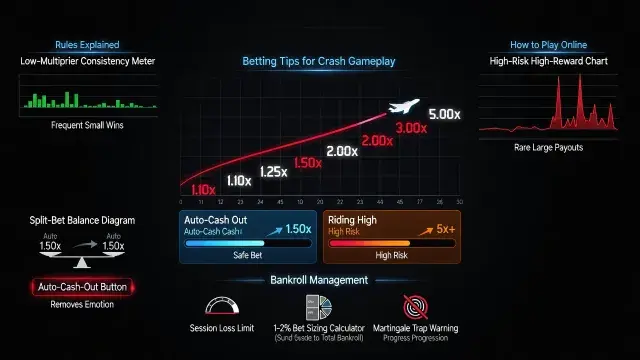
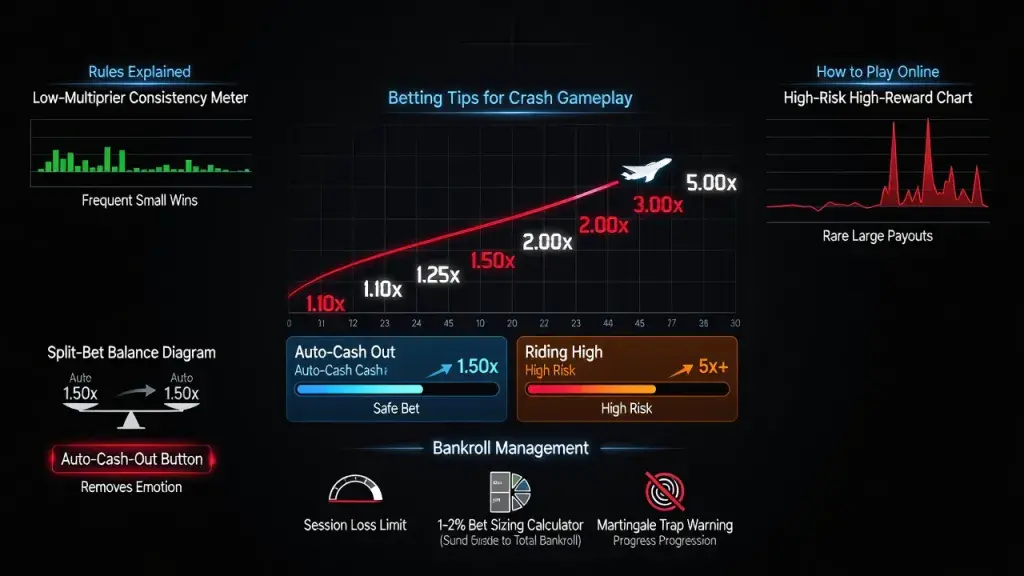
This method involves cashing out early and often, typically between 1.20x and 1.50x, aiming for frequent small wins rather than occasional large ones. It suits players who prioritize steady bankroll movement over big swings, though it requires many successful rounds to offset even a single large loss from an overextended bet.
The High-Risk, High-Reward Method
Some players set a target multiplier well above 5x and let the bet ride, accepting that most rounds will end in a loss. This approach depends heavily on bankroll size and emotional discipline, since long losing streaks are statistically normal even when the eventual payout could be substantial.
The Split-Bet Strategy
Using the two-bet feature, players often cash out one wager early to bank a guaranteed small profit while letting the second run toward a higher target. This hybrid method balances the psychological comfort of a win with the potential for a larger payout on the second bet.
Using Auto-Cash-Out to Remove Emotion
Manual cash-outs are vulnerable to hesitation - the temptation to wait "just one more second" has cost countless players a guaranteed profit. Presetting an auto-cash-out target removes that emotional variable entirely and enforces consistency across sessions.
- Low-multiplier approach: frequent small wins, lower variance
- High-risk approach: rare large wins, higher variance
- Split-bet approach: balances safety and upside in a single round
- Auto-cash-out: removes reaction-time and emotional risk
Aviator Game Betting Tips for Bankroll Management
Strategy determines when to cash out; bankroll management determines how long you stay in the game at all.
Setting a Session Loss Limit
Decide before playing how much you're willing to lose in a single session, and stop the moment that threshold is reached. This single habit prevents the most common cause of significant losses: chasing a downswing with increasingly large bets.
Sizing Bets Relative to Total Bankroll
A common guideline is wagering no more than one to two percent of total bankroll per round. This keeps any single crash from meaningfully damaging your overall funds and allows for extended play even through losing streaks.
Avoiding the Martingale Trap
Doubling bets after every loss, in hopes that one win recovers everything, is mathematically seductive and practically dangerous. Table limits and finite bankrolls mean a long losing streak - which happens more often than intuition suggests - can wipe out funds before a recovery bet is even possible.
Tracking Results Across Sessions
Keeping a simple log of bet size, cash-out multiplier, and outcome reveals patterns in personal behavior that raw memory misses, such as a tendency to increase bets impulsively after a win.
Common Mistakes to Avoid in Aviator Crash Game Gameplay
Most losses in Aviator stem from behavioral errors rather than bad luck.
Chasing Losses With Bigger Bets
Increasing stake size to recover a previous loss feels intuitive but ignores that each round is independent. The multiplier has no memory of past crashes, and betting bigger doesn't shift the odds in your favor.
Waiting Too Long for a "Big One"
Greed is the most consistent reason a guaranteed profit turns into a total loss. Watching a multiplier climb past 4x or 5x and refusing to cash out in hope of 10x is a common and costly pattern.
Ignoring Provably Fair Verification
Players who never check round verification data miss an easy way to confirm the platform they're using is operating honestly, leaving trust in the game unnecessarily untested.
Frequently Asked Questions
Is there a way to predict when the plane will crash?
No. The crash point is generated randomly for each round and verified through provably fair systems, meaning no visual cue, pattern, or betting history can reliably predict it. Any claim of a prediction tool or pattern-reading method should be treated as false.
How much money should I start with as a beginner?
Start with an amount you're comfortable losing entirely, often a small fraction of your total gambling budget. Many players begin with the minimum bet allowed on the platform to learn the timing and interface before increasing stake size.
Can auto-cash-out guarantee a profit?
Auto-cash-out guarantees that your target multiplier will be honored if the round reaches it, but it cannot guarantee the round will reach that multiplier at all. It removes reaction delay and emotional decision-making, not risk itself.
Is Aviator rigged or fixed against players?
Licensed versions of the game use provably fair algorithms that players can independently verify after each round. Choosing a properly licensed platform is the best safeguard against manipulated outcomes.
What's the difference between Aviator and traditional slot games?
Slots resolve instantly with no player input after the spin begins, while Aviator gives players an active decision window to cash out at any point during a round. This makes Aviator feel more interactive, though the underlying randomness is comparable.
Should I use the same strategy every session?
Consistency helps with tracking and discipline, but adjusting bet size based on current bankroll and recent results is reasonable. What matters most is sticking to predetermined loss limits regardless of which specific strategy you follow.
![[GPT ERROR] Error: Invalid value parameter. Received: #ERROR! - Guía completa para entender y solucionar este fallo](/sites/bet365web.org/files/styles/medium/public/content/images/2026-08/9acb8ba8930690034e25581f6de7fcbc6c8905ab.webp?itok=pPnELKJE)