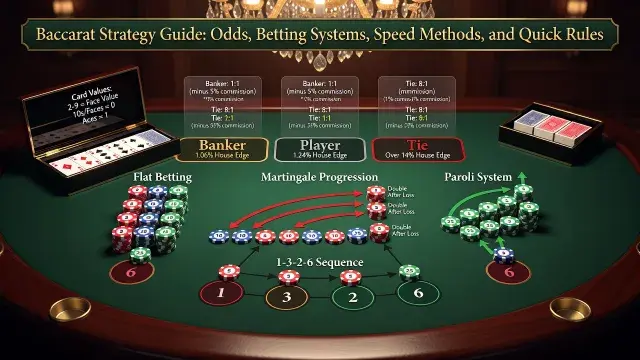
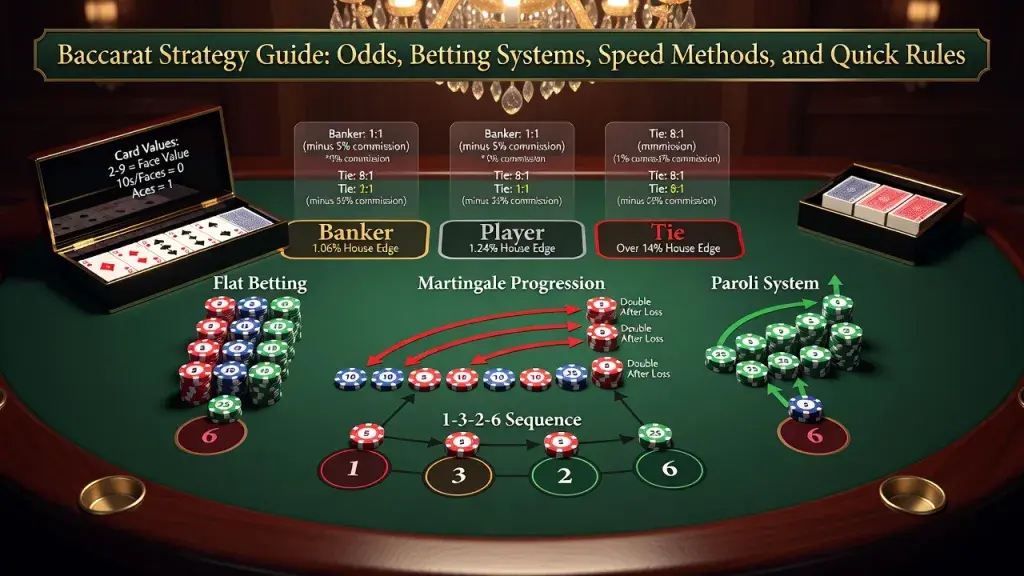
A shoe of eight decks contains 416 cards, yet the house edge on the Banker bet sits at roughly 1.06 percent - one of the tightest margins in the casino. Few games offer this combination of simplicity and mathematical fairness, which is precisely why baccarat has quietly become a favorite among players who prefer calculated decisions over guesswork. The rules take five minutes to learn. Mastering the odds behind those rules takes considerably longer.
This guide breaks down what actually matters: the real probabilities behind each wager, the betting systems that hold up under scrutiny, and the accelerated formats now dominating online tables. Anyone shifting from a standard shoe to a faster format should understand how timing changes decision-making - a topic covered in depth in this breakdown of speed baccarat a strategy, which explains how compressed round times affect bankroll planning. From there, we move into the practical mechanics every player needs before sitting down at a table, live or digital.
Baccarat rewards patience and punishes assumption. Players who understand the numbers behind each bet consistently outlast those relying on instinct alone. What follows is a structured breakdown of odds, systems, and rules built for readers who want results, not folklore.
Understanding Baccarat Odds
House Edge by Bet Type
Baccarat odds vary sharply depending on which of the three bets a player chooses. The Banker bet carries a house edge near 1.06 percent, the Player bet sits around 1.24 percent, and the Tie bet - despite its tempting payout - carries an edge that typically exceeds 14 percent. That gap alone should dictate most betting decisions. The Tie bet looks attractive on paper because of its 8:1 or 9:1 payout, but the actual frequency of ties makes it a poor long-term choice.
Why the Banker Bet Wins More Often
The Banker's statistical advantage comes from the drawing rules that govern the third card. Because the Banker hand acts after seeing the Player's result, it gains a structural edge that the casino compensates for with a commission, usually five percent, on Banker wins. Even after that commission, the Banker bet remains the mathematically superior choice over thousands of hands.
Payout Structures and Commission
Standard payouts run even money on both Player and Banker bets, with the Banker commission being the only deduction. Some tables now offer commission-free variants, but these typically adjust payouts on specific winning totals, such as a Banker win with a six, to rebalance the house edge. Reading the table rules before playing matters more than most players realize.
- Banker bet: approximately 1.06% house edge
- Player bet: approximately 1.24% house edge
- Tie bet: house edge typically above 14%
Core Baccarat Strategy Principles
Bet Selection Discipline
A sound baccarat strategy starts with accepting that the Banker bet, despite its commission, remains the most defensible wager on the table. Players who chase Tie bets for their higher payout consistently erode their bankroll faster than those who stick to Banker or Player. Discipline in bet selection outperforms any pattern-reading technique.
Bankroll Management Fundamentals
Setting a fixed session budget and a stop-loss threshold prevents the emotional spiral that ruins most gambling sessions. A common approach involves dividing a bankroll into units equal to five percent of the total, betting one unit per hand, and stopping once a predetermined loss limit is reached. This structure keeps variance from turning a bad run into a financial disaster.
Avoiding Common Mistakes
New players frequently fall into the trap of "trend chasing" - betting on Banker after several consecutive Banker wins, assuming the streak will continue. Baccarat outcomes are independent between hands; no prior result changes the probability of the next. Recognizing this breaks a habit that costs players significant money over time.
Baccarat Betting Strategies Compared
Flat Betting
Flat betting means wagering the same amount on every hand regardless of previous outcomes. It's the simplest of all baccarat betting strategies and the one least likely to cause catastrophic bankroll swings. Professional players often favor flat betting precisely because it removes emotion from the equation.
Progressive Systems: Martingale and Paroli
The Martingale system doubles the bet after every loss, aiming to recover previous losses with a single win. It works mathematically only with an unlimited bankroll and no table limits - conditions that don't exist in practice. The Paroli system takes the opposite approach, doubling bets after wins and resetting after losses, which limits downside exposure while still capturing winning streaks.
The 1-3-2-6 Method
This system structures four consecutive bets in the ratio of 1, 3, 2, and 6 units, adjusting the sequence based on wins and resetting after any loss. It caps potential losses at a known amount while allowing profit to compound during a winning run, making it one of the more balanced betting systems, especially for volatile shoes.
Why No System Beats the House Edge
Every betting system reshuffles risk and reward; none change the underlying probability. The house edge on Banker and Player bets remains fixed no matter how bets are structured across a session. Betting systems manage variance and bankroll exposure - they don't create an advantage that doesn't exist mathematically.
Speed Baccarat System and Modern Formats
How Speed Baccarat Differs From Traditional Play
A speed baccarat system compresses the standard round - dealing, betting window, and payout - into a fraction of the usual time, often under thirty seconds per hand. This format removes much of the ceremonial pacing found in traditional live tables, appealing to players who want more hands per hour without altering the underlying rules.
Adjusting Bankroll Strategy for Faster Rounds
Because speed formats multiply the number of hands played in a given session, bankroll depletion happens faster if betting size isn't recalibrated. Reducing unit size relative to standard tables helps offset the increased hand frequency, keeping the same overall risk exposure across a session of equal length.
Mental Focus in High-Speed Play
Faster rounds leave less time for deliberation, which can push players toward impulsive bets. Maintaining a predetermined strategy before the session begins - rather than deciding hand-to-hand - becomes essential when the pace accelerates. Players who adapt their flat betting or progressive system to the faster rhythm tend to preserve bankroll discipline far better than those improvising under time pressure.
Baccarat Quick Rules Every Player Should Know
Card Values and Hand Totals
Cards two through nine hold face value, tens and face cards count as zero, and aces count as one. Hand totals reset at ten, so a hand of seven and eight equals five, not fifteen. Understanding this single rule eliminates most early confusion for new players.
The Third-Card Drawing Rule
Both Player and Banker hands follow fixed drawing rules based on their initial two-card total. A Player total of five or lower draws a third card automatically, while totals of six or seven stand. The Banker's decision to draw depends on both its own total and the Player's third card, following a fixed chart that dealers apply automatically.
Natural Wins and Instant Settlements
A two-card total of eight or nine is called a "natural," and it ends the hand immediately without further drawing. Naturals settle bets on the spot, which is part of why baccarat rounds move quickly even in traditional formats - and even faster in accelerated ones.
Building a Personal Baccarat Game Plan
Matching Strategy to Bankroll Size
Smaller bankrolls benefit from flat betting and strict stop-loss limits, since progressive systems require reserves that casual players rarely have. Larger bankrolls can absorb the swings of systems like Paroli or 1-3-2-6 without risking the entire session on a single downturn.
Choosing Between Standard and Speed Tables
Players who value deliberation and social pacing tend to prefer standard tables, while those focused on volume and efficiency gravitate toward speed formats. Neither format changes the underlying odds - the choice comes down to personal pacing preference and how well a player's chosen system adapts to compressed decision windows.
Tracking Results Without Overreacting
Keeping a simple log of wins, losses, and bet sizes across sessions helps identify whether a chosen system is sustainable over time, without falling into the trap of reading meaning into short-term streaks. Long-run consistency, not short-term luck, is the real measure of a working strategy.
Frequently Asked Questions
Is the Banker bet always the best choice in baccarat?
Statistically, yes - the Banker bet carries the lowest house edge of the three main wagers, even after accounting for the standard commission. The only exception involves rare commission-free variants with adjusted payout rules, which require checking the specific table conditions before assuming Banker is optimal.
Can betting systems guarantee long-term profit?
No betting system changes the house edge or guarantees profit over time. Systems like Martingale, Paroli, and 1-3-2-6 restructure how losses and wins are distributed across a session, which can smooth variance but cannot overcome the fixed mathematical disadvantage built into the game.
How is speed baccarat different from live baccarat in terms of risk?
Speed baccarat doesn't change the odds of any bet, but it increases the number of hands played per hour, which raises total bankroll exposure over a session of the same length. Adjusting bet size downward compensates for this faster pace and keeps overall risk comparable to slower formats.
What's the safest baccarat strategy for beginners?
Flat betting on the Banker hand, combined with a strict stop-loss limit, gives beginners the most predictable and manageable experience. It avoids the compounding risk of progressive systems while still capturing the statistical advantage the Banker bet offers over Player or Tie.
Why does the Tie bet have such a high house edge despite its big payout?
Ties occur far less frequently than the payout might suggest, and the odds are calculated to favor the house heavily on this bet. Even a payout of 8:1 or 9:1 doesn't compensate for how rarely a tie actually happens across a standard eight-deck shoe.
Do baccarat quick rules change between online and physical casinos?
The core rules - card values, third-card drawing conditions, and natural wins - remain standardized across virtually all baccarat formats, online or physical. Differences usually involve pacing, commission structures, or side bets, not the fundamental drawing rules themselves.
![[GPT ERROR] Error: Invalid value parameter. Received: #ERROR! - Guía completa para entender y solucionar este fallo](/sites/bet365web.org/files/styles/medium/public/content/images/2026-08/9acb8ba8930690034e25581f6de7fcbc6c8905ab.webp?itok=pPnELKJE)