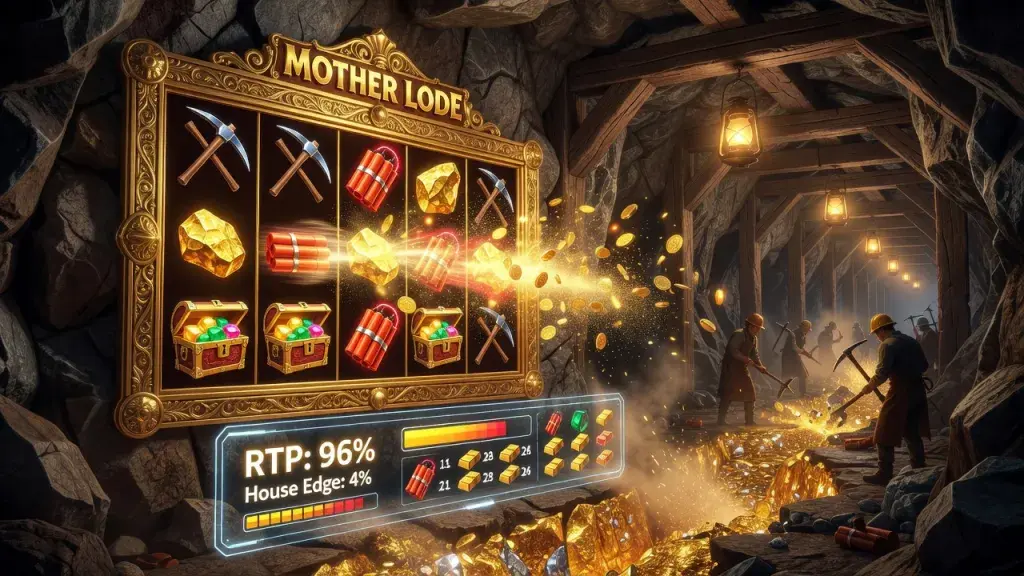
A slot's return-to-player figure is the single most concrete piece of data a player can use before spinning a single reel, yet most people never check it. The dynamite riches mother lode rtp sits at a level that places the title firmly among the more transparent options in a market where operators often bury this information three menus deep. Understanding what that number actually means, and how it plays out over hundreds or thousands of spins, separates informed players from those relying purely on instinct.
This piece breaks down the mechanics behind the dynamite riches slot RTP, explains how it compares against industry benchmarks, and walks through what the figure tells you about volatility, session length, and realistic expectations. Anyone weighing whether to try the game can review the dynamite riches the mother lode rtp details directly through the official listing before committing real funds, which gives a clearer starting point than guesswork. From there, the analysis moves into how RTP interacts with bonus rounds, jackpot mechanics, and the broader iGaming environment where these percentages are calculated and audited.
By the end, you will understand not just the number itself but the reasoning behind it - why it matters, how it's verified, and what it does and doesn't predict about your own results at the table.
What RTP Actually Means in Online Slot Games
The Mathematical Definition Behind the Percentage
Return to player is a theoretical average calculated across millions of simulated spins, not a promise for any individual session. If a game carries a 96% RTP, the math says that for every 100 units wagered across its full lifecycle, 96 units return to players collectively. This figure comes from the game's underlying paytable and probability weighting, tested and certified by independent labs before a title goes live. It has nothing to do with luck on a given Tuesday afternoon - it's a long-run statistical property baked into the code.
Why This Number Differs From House Edge
House edge and RTP are two sides of the same coin. If a game returns 96%, the house edge is 4% - the portion the operator retains on average. Players sometimes confuse the two, assuming a high RTP guarantees frequent wins, when in fact it only describes the ratio over an extended timeframe. Short sessions can and do deviate wildly from the theoretical average in either direction.
How RTP Gets Verified and Published
Testing agencies run extensive simulations on a slot's random number generator and paytable structure before certifying the stated percentage. Regulators in most licensed jurisdictions require this disclosure, though the format and visibility vary by operator. Some platforms list the number in the game's info screen; others require digging through a help menu or a separate paytable page.
- RTP is calculated pre-launch through simulation, not observed after the fact from live play
- It represents an average across the full theoretical lifecycle of the game, not a short-term guarantee
- Independent testing labs certify the figure before regulators approve the game for release
Dynamite Riches Mother Lode RTP: The Core Numbers
Where the Mother Lode RTP Rate Stands Against Industry Norms
The mother lode RTP rate falls within a range that most industry observers would call competitive rather than exceptional or weak. Typical online slots cluster between 94% and 97%, and titles positioned in the upper half of that band tend to attract more attention from players who track this metric closely. Knowing where a specific game lands within that spread gives context - a 96% title behaves quite differently over time than one sitting at 92%, even though both numbers might look similar at a glance.
Fixed Percentage or Variable Configuration
Some slot titles ship with multiple RTP configurations, allowing individual operators to select a version before deploying the game on their platform. This practice is legal and disclosed, but it means the number quoted on one site might not match another running the same title. Checking the specific RTP listed on the platform where you intend to play matters more than relying on a general figure quoted elsewhere.
How the Mining Theme Ties Into the Payout Structure
The game's mother lode theme, built around excavation and buried treasure, isn't just cosmetic - it frames the bonus mechanics that contribute to the overall RTP calculation. Bonus features, free spin triggers, and any progressive or fixed jackpot elements all factor into the blended percentage that gets certified and published. A game with a rich bonus round often distributes more of its return through those features rather than base-game spins alone.
Dynamite Riches Slot RTP Compared to Similar Titles
Benchmarking Against Other Mining and Treasure-Themed Slots
Treasure and prospecting themes are common in the slot catalog, and comparing dynamite riches slot RTP against similarly themed competitors gives useful perspective. Titles in this niche often sit close together in percentage terms because they compete for the same audience segment, and operators know that publishing a noticeably lower RTP than rivals can hurt retention.
Volatility and RTP Working Together
RTP alone doesn't describe the player experience - volatility (or variance) shapes how that return gets distributed. A high-RTP, high-volatility slot might pay out rarely but generously, while a high-RTP, low-volatility game pays smaller amounts more frequently. Understanding both metrics together paints a fuller picture than either number in isolation.
What Changes Between Desktop and Mobile Versions
Reputable developers keep RTP identical across platforms, since altering the figure by device would violate most licensing agreements. Still, it's worth confirming this consistency directly on the platform you use, since interface differences can occasionally mask configuration variants between versions.
- Compare RTP figures across at least three similarly themed titles before choosing where to play
- Check volatility ratings alongside RTP for a complete risk profile
- Confirm the percentage listed matches across desktop and mobile versions of the same game
Understanding Online Slot Game RTP in Context
Theoretical Return Versus Real Session Outcomes
A common misunderstanding treats online slot game RTP as a short-term predictor rather than a long-run average. Over a 50-spin session, results can swing far above or below the stated percentage purely due to variance. Only across thousands of spins does the actual return begin to converge meaningfully toward the certified figure.
Bankroll Management Given a Known RTP
Knowing the RTP lets a player make more informed decisions about session length and bet sizing. A lower RTP combined with high volatility calls for a larger bankroll buffer to survive the dry spells between bigger hits. Conversely, a higher RTP with lower volatility suits players who prefer steadier, smaller returns over a longer play window.
Common Misreadings of the RTP Figure
Players sometimes assume RTP applies per-session or per-day, expecting a 96% game to return 96% of their stake by the end of a single evening. That's not how the math works - the figure only holds true across an enormous sample size, far beyond what any individual typically plays.
Dynamite Riches iGaming RTP: Regulation and Transparency
Licensing Bodies and Disclosure Requirements
Licensed operators must display or make available the certified RTP for every game on their platform, a requirement enforced by regulators across most major jurisdictions. The dynamite riches iGaming RTP figure, like that of any regulated title, has passed through independent testing before reaching public listings, giving players a verifiable baseline rather than a marketing claim.
How Auditing Labs Test and Certify RTP
Testing labs run statistical simulations across millions of spin cycles, confirming that the random number generator produces outcomes consistent with the intended paytable. These audits happen before launch and are periodically reviewed, ensuring the published percentage remains accurate over the game's lifespan.
Why Transparency Builds Player Trust
Operators that make RTP figures easy to find tend to build stronger reputations among experienced players, who increasingly treat this transparency as a baseline expectation rather than a bonus feature. Games and platforms that obscure this data invite skepticism, regardless of how fair the underlying mechanics actually are.
Practical Tips for Playing With RTP in Mind
Setting Realistic Expectations Before You Play
Treat the RTP figure as a guide to long-term behavior, not a forecast for your next session. Set a budget you're comfortable losing entirely, since even a well-above-average RTP doesn't eliminate the possibility of a losing streak within any given sitting.
Choosing Bet Sizes Relative to Volatility
Smaller, more frequent bets suit low-volatility games with steady payout patterns, while larger, less frequent bets align better with high-volatility titles where the bigger wins arrive less often but hit harder. Matching your bet size to the game's actual risk profile, rather than a fixed personal habit, tends to produce a more satisfying experience.
Where to Verify RTP Before Committing Funds
Always check the in-game paytable or help screen for the specific RTP configuration running on your chosen platform, since this can vary between operators even for the same title. Cross-referencing that figure against independent slot databases adds a layer of confirmation before you deposit.
Frequently Asked Questions
Does a higher RTP mean I'll win more often?
Not necessarily. RTP describes the average return across a very large number of spins, not the frequency of individual wins. A high-RTP slot can still be highly volatile, meaning wins arrive rarely but pay out more when they do.
Can the RTP of a slot change after release?
In regulated environments, operators cannot alter a certified RTP without re-submitting the game for testing and approval. If a title offers multiple configurations, the specific version deployed on a platform stays fixed unless formally updated and re-certified.
Is RTP the same thing as my chances of hitting the jackpot?
No. RTP is a blended average that includes base-game payouts, bonus features, and any jackpot contributions combined into one percentage. Jackpot hit frequency is a separate statistic, usually far lower probability, that isn't directly readable from the RTP figure alone.
Why do RTP figures sometimes differ between casinos for the same game?
Some game providers offer multiple RTP configurations for operators to select from before launch, all within a legally disclosed range. This means the same title can carry slightly different certified percentages depending on which platform you play it on.
How many spins does it take for actual returns to match the stated RTP?
There's no fixed threshold, but convergence toward the theoretical average typically requires tens of thousands of spins or more. Short sessions of a few dozen or even a few hundred spins can deviate substantially from the published figure in either direction.
Should RTP be the only factor I consider before choosing a slot?
No. Volatility, maximum win potential, bonus feature frequency, and your own bankroll size all matter alongside RTP. A game with a strong RTP but mismatched volatility for your bankroll can still lead to a frustrating experience.
![[GPT ERROR] Error: Invalid value parameter. Received: #ERROR! - Guía completa para entender y solucionar este fallo](/sites/bet365web.org/files/styles/medium/public/content/images/2026-08/9acb8ba8930690034e25581f6de7fcbc6c8905ab.webp?itok=pPnELKJE)