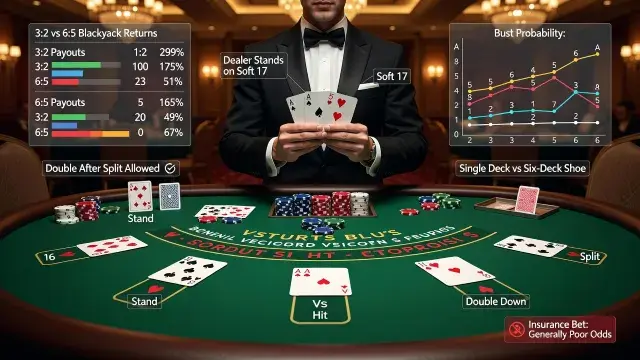
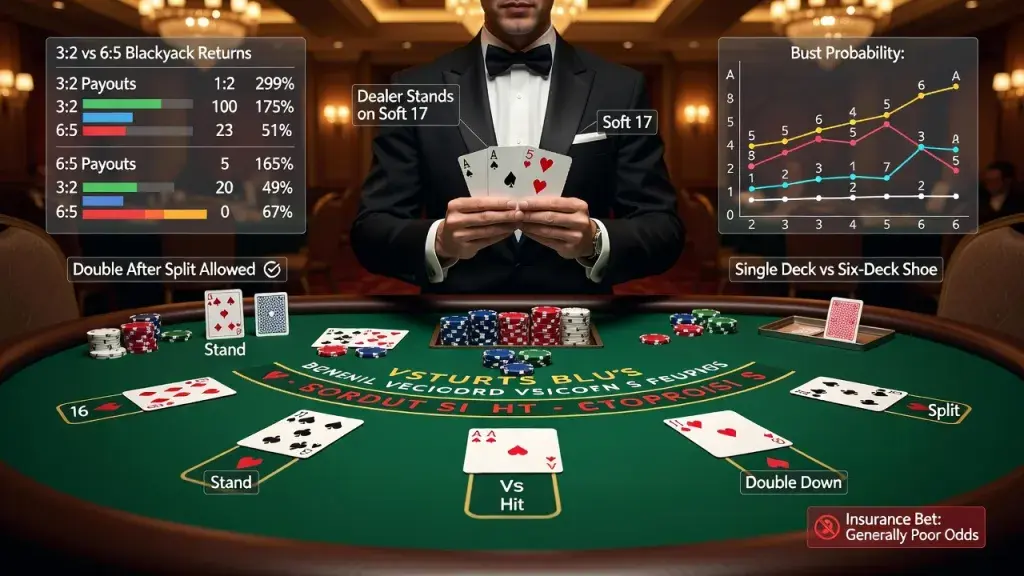
A single procedural detail - whether the dealer hits or stands on a soft 17 - shifts the house edge by roughly 0.2 percent. That fraction sounds trivial until you realize it can determine whether a skilled player is fighting a 0.5 percent disadvantage or a 1.5 percent one over thousands of hands. Blackjack is unusual among casino games because so much of its outcome depends on rules that vary from table to table, not just on chance.
Most gamblers learn basic strategy charts and assume that's the whole game. It isn't. The number of decks in play, whether you can double down after splitting, and how surrender is handled all move the odds in measurable ways - sometimes more than a player's skill level does. Before sitting at any table, it helps to understand what is blackjack in casino terms specifically: a comparison game against the dealer, not the other players, where every rule variant changes your realistic chances of winning. That distinction matters because it means your strategy must adapt to the house rules posted at each table, not to a single memorized formula.
This piece breaks down the mechanics that actually move the needle: how payouts affect long-term returns, why dealer procedures matter more than most players think, and which strategic adjustments respond directly to table conditions. The goal is practical fluency, not trivia.
Understanding the Core Blackjack Rules
Before any strategy makes sense, the mechanical rules need to be second nature. Blackjack looks simple on the surface - get closer to 21 than the dealer without going over - but the procedural details beneath that surface are what separate a break-even player from a losing one.
Objective and Card Values
The goal is not to hit 21 exactly; it's to beat the dealer's hand total without busting. Number cards count at face value, face cards count as ten, and the ace flexes between one and eleven depending on what benefits the hand. A hand containing an ace valued at eleven without busting is called "soft," and this distinction directly affects decision-making later on.
Player Options: Hit, Stand, Double, Split
Every turn presents a decision tree. Players can hit to take another card, stand to keep their total, double down to double the wager in exchange for exactly one more card, or split a pair into two separate hands. Some tables also allow surrender, letting a player forfeit half the bet and exit a clearly unfavorable hand early.
Table Variations Worth Knowing
Blackjack rules are not standardized across casinos. Deck count, whether the dealer checks for blackjack before play continues, and how doubling after splitting is handled all differ. These variations aren't cosmetic - they change the mathematical foundation of every hand played.
- Single-deck versus six- or eight-deck shoes
- Dealer hits or stands on soft 17
- Double down allowed on any two cards versus restricted totals
- Resplitting aces permitted or forbidden
Blackjack Odds and Probabilities Explained
Blackjack draws serious players because it's one of the few casino games where the house edge can drop below one percent with correct play. That's not luck - it's math built on card composition and dealer constraints.
House Edge Under Standard Rules
Under commonly used rule sets with proper basic strategy, the house edge typically sits between 0.5 and 1 percent. That's dramatically lower than roulette or slot machines, where the edge often runs into the several-percent range. The precise figure moves depending on deck count and dealer rules, which is why table selection matters as much as playing skill.
Why Card Composition Matters
As cards are dealt and removed from the shoe, the remaining composition shifts. A deck richer in high cards favors the player, since blackjacks pay more and dealers bust more often on stiff hands. This principle is the foundation of card counting, though modern multi-deck shoes and shuffling procedures have made the technique far less practical than it once was.
Bust Probabilities by Dealer Upcard
Dealer upcards correlate strongly with bust likelihood. A dealer showing a 5 or 6 busts noticeably more often than one showing a 7 through ace, which is precisely why basic strategy charts tell players to stand on marginal totals against weak upcards and hit against strong ones.
Blackjack Payout Structures and Their Impact
Payout ratios are where many players unknowingly hand the casino an advantage. The difference between a 3:2 and a 6:5 blackjack payout looks small on a felt sign but compounds into a meaningful edge shift over a session.
Standard 3:2 Payout Explained
A traditional blackjack pays 3:2, meaning a $10 bet returns $15 in profit on a natural blackjack. This ratio has been the industry standard for decades and is baked into most house-edge calculations that players reference when evaluating a game.
The 6:5 Trap
Some tables, particularly on single-deck games marketed as player-friendly, actually pay only 6:5 on blackjacks. This seemingly minor change increases the house edge by more than a full percentage point - often erasing any advantage gained from the reduced deck count. Recognizing this payout difference before sitting down is one of the simplest ways to protect your bankroll.
Side Bets and Insurance Payouts
Insurance pays 2:1 but is a poor bet mathematically for most players, since it only breaks even when the dealer has blackjack roughly one-third of the time - a frequency rarely matched by actual deck composition. Side bets like Perfect Pairs or 21+3 carry payouts that look attractive but typically carry house edges well above the base game.
Blackjack vs Dealer Rules: What Really Changes the Game
The relationship between player and dealer is asymmetric by design. Dealers follow fixed, mechanical rules with no discretion, while players make active choices. Understanding that asymmetry is central to reading any table correctly.
Soft 17: Hit or Stand
Whether the dealer hits or stands on soft 17 is one of the most cited rule variations in blackjack literature. Dealers who hit on soft 17 give the house a slightly larger edge, since it gives them more chances to improve a marginal hand into a strong one.
Dealer Peek and Blackjack Checks
In most American-style games, the dealer peeks at the hole card when showing an ace or ten to check for blackjack before players act further. In European-style games without this peek, players can lose additional bets - through doubling or splitting - to a dealer blackjack revealed later, a subtle but real difference in expected loss.
No Player Discretion for Dealers
Dealers must hit below 17 and stand at 17 or above, with no room for judgment. This rigidity is actually exploitable: because dealer behavior is fully predictable, players can calculate exact probabilities for every scenario, which is the entire basis of basic strategy charts.
Blackjack Casino Strategy for Long-Term Play
Strategy in blackjack isn't about intuition - it's about applying probability-based decisions consistently, hand after hand, regardless of recent outcomes.
Basic Strategy Charts
A basic strategy chart tells you the statistically optimal action for every combination of player total and dealer upcard. Deviating from it, even based on a "feeling," increases the house edge measurably over time.
Bankroll Management
Sound bankroll management means setting bet sizes relative to total funds and sticking to them regardless of a winning or losing streak. Chasing losses by increasing bets erratically is the fastest way to turn a small house edge into a significant loss.
Table Selection as Strategy
Choosing a table with favorable rules - 3:2 payouts, dealer stands on soft 17, liberal doubling and splitting options - often does more for your odds than any in-game decision. Two players with identical skill can face dramatically different house edges purely based on which table they sat down at.
- Prefer 3:2 payouts over 6:5
- Look for dealer stands on soft 17 when available
- Favor tables allowing doubling after splitting
- Avoid high-vig side bets unless purely for entertainment
Common Mistakes That Undermine Blackjack Strategy
Even players familiar with the rules often sabotage their own odds through habits that feel intuitive but aren't statistically justified.
Taking Insurance Without Understanding the Math
Insurance feels protective, but it's a separate bet with its own unfavorable math. Taking it regularly, rather than in the rare situations where card counting genuinely favors it, quietly drains a bankroll over time.
Ignoring Dealer Upcard Context
Standing on a marginal total without factoring in the dealer's upcard is one of the most common errors among casual players. A total of 16 against a dealer's 6 calls for standing; the same 16 against a dealer's 9 or 10 usually calls for hitting, despite feeling riskier.
Playing Rule Variants Without Adjusting
Basic strategy charts differ slightly depending on deck count and dealer rules. Applying a single-deck strategy chart to a six-deck shoe, or vice versa, introduces small but real errors that accumulate across a session.
Frequently Asked Questions
Is card counting still effective in modern casinos?
It's far less effective than it once was. Multi-deck shoes, frequent shuffling, and continuous shuffling machines have significantly reduced the advantage counters can gain, though it remains theoretically valid against certain single- or double-deck games with deep penetration.
What's the single biggest mistake new players make?
Playing hunches instead of following basic strategy. Emotional decisions - standing out of fear or hitting out of impatience - consistently perform worse than the mathematically derived chart action, even when they feel intuitively correct.
Does the number of decks really matter that much?
Yes, though less than payout structure or dealer rules. Single-deck games generally favor players slightly more than multi-deck shoes, but a single-deck table with a 6:5 payout can still be worse than a six-deck table paying 3:2.
Should I ever deviate from basic strategy?
Only if you're using a verified card-counting system that accounts for the current deck composition. Outside of that, deviating from basic strategy based on gut feeling almost always increases the house edge rather than reducing it.
Why do some tables pay 6:5 instead of 3:2 on blackjack?
Casinos use 6:5 payouts, often on single-deck or double-deck games, to recapture some of the player advantage those lower deck counts otherwise provide. It's a trade-off that usually isn't worth accepting, since the payout reduction outweighs the deck-count benefit.
How much does the dealer hitting on soft 17 actually cost me?
It increases the house edge by roughly 0.2 percent compared to a dealer standing on soft 17. That may sound minor, but across thousands of hands, it represents a real and measurable difference in expected losses.